
• Last updated: 2026-11-05 • ~8 min read • Career Guide
- 1. What Is a Siddha Doctor?
- 2. Educational Qualification Required to Become a Siddha Doctor
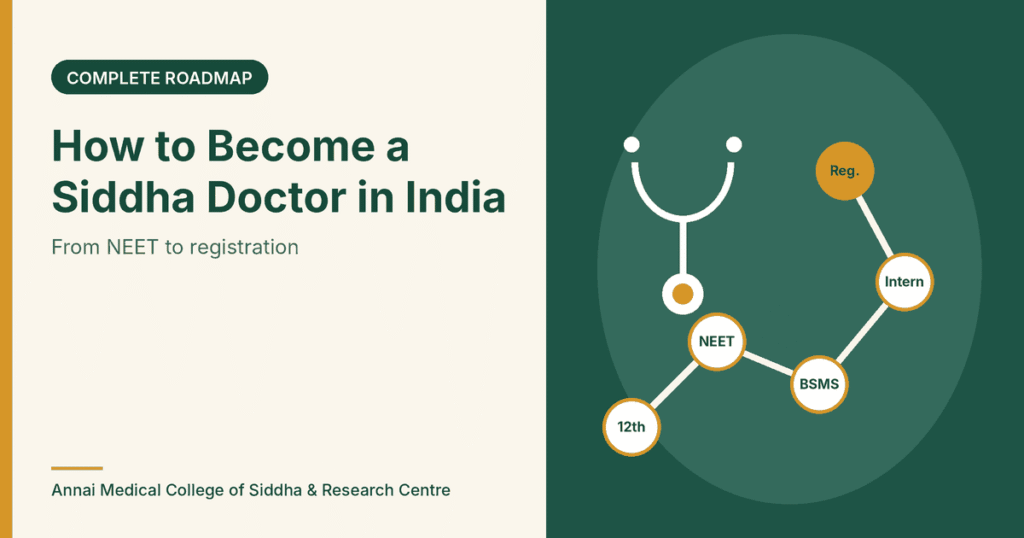
- 3. Step-by-Step Roadmap to Become a Siddha Doctor
- 4. BSMS Course Duration and Subjects
- 5. How to Get Siddha Medical Registration in India
- 6. How to Obtain a Siddha Practice Licence
- 7. Career Opportunities After BSMS
- 8. Conclusion
- 9. Frequently Asked Questions (FAQs)
Siddha medicine is one of India’s oldest traditional systems of healthcare, with deep historical roots in Tamil Nadu. It focuses on maintaining health and treating illnesses through traditional medicines, dietary practices, and lifestyle management.
For students interested in traditional medicine, becoming a Siddha doctor can be a rewarding career path. However, it requires the right educational qualification, professional clinical training, and statutory registration to practise legally.
If you are wondering how to become a Siddha doctor, this complete guide explains the eligibility criteria, the BSMS course, the admission process, the internship structure, registration requirements, and career opportunities in India.
To become a licensed Siddha doctor in India, qualify NEET-UG, complete the 5½-year Bachelor of Siddha Medicine and Surgery (BSMS) degree (including a 1-year compulsory rotatory internship), and secure professional medical registration with your State Siddha Medical Council.
Holding a BSMS degree alone does not permit clinical consultations; obtaining state registration (such as through the Tamil Nadu Siddha Medical Council) is mandatory before initiating independent practice.
1. What Is a Siddha Doctor?
A Siddha doctor is a qualified healthcare professional trained in the classical Siddha system of medicine. Siddha is a traditional Indian medical system that originated in Tamil Nadu and is based on fundamental principles of health preservation, disease prevention, and natural treatments.
A recognised Siddha medical graduate completes an approved BSMS degree under the regulatory supervision of the National Commission for Indian System of Medicine (NCISM) and fulfills the applicable council registration requirements before practising clinically.
2. Educational Qualification Required to Become a Siddha Doctor
The first step toward becoming a practitioner is satisfying the eligibility criteria for admission into the Bachelor of Siddha Medicine and Surgery (BSMS) programme:
- Higher Secondary Education: Pass Class 12 (+2) or an equivalent examination recognized by the state or central education board.
- Mandatory Subjects: Physics, Chemistry, and Biology (or Botany & Zoology).
- Minimum Marks: Under current NEET-UG admission criteria, candidates must secure at least 50% aggregate marks in PCB for the General category and 40% for SC, ST, and OBC candidates.
- Entrance Exam: Secure the minimum qualifying percentile in the NEET-UG entrance exam for the corresponding academic session.
- Age Criterion: Candidates must be at least 17 years old on or before 31 December of the admission year.
Important Note: Always review the latest AYUSH counselling notification issued by the state Directorate of Indian Medicine and Homoeopathy (DIM&H) for updated reservation rules and eligibility nuances before applying.
3. Step-by-Step Roadmap to Become a Siddha Doctor
Follow these progressive stages to build your career as a registered Siddha medical practitioner:
- Step 1: Complete 12th Standard with Science
Opt for the Science stream (Physics, Chemistry, and Biology) in higher secondary schooling and maintain strong academic fundamentals. - Step 2: Qualify NEET-UG
Register, appear for, and clear the National Eligibility cum Entrance Test (NEET-UG). Merit rankings from NEET determine seat allotment in government and self-financing Siddha colleges. - Step 3: Participate in AYUSH Counselling & Secure Admission
Apply through the official state counselling process (or AACCC for central seats). Select approved institutions recognized by NCISM and affiliated with reputed medical universities. - Step 4: Complete the BSMS Degree Programme
Undergo 4½ years of rigorous didactic coursework, anatomy dissections, laboratory practicals, and clinical ward postings. - Step 5: Complete the 1-Year Compulsory Internship (CRRI)
Receive hands-on, rotatory clinical hospital training covering general medicine, surgery, external therapies, obstetrics, and emergency procedures. - Step 6: Secure Professional Medical Registration
Submit credentials to the State Siddha Medical Council to obtain your license and registration certificate, granting legal authorization to practise.
4. BSMS Course Duration and Subjects
The BSMS course combines theoretical learning, clinical education, and hospital training structured across dedicated academic phases:
| Course Stage | Duration |
|---|---|
| First Professional | 18 Months |
| Second Professional | 18 Months |
| Final Professional | 18 Months |
| Compulsory Rotatory Internship (CRRI) | 12 Months |
| Total Duration | 5½ Years |
Major Subjects Covered
The NCISM-regulated curriculum ensures mastery of traditional medical science integrated with standard medical diagnostic knowledge:
- Siddha Fundamentals & Philosophy: Siddha Maruthuva Moola Thathuvam, History of Siddha Medicine.
- Pre-Clinical Sciences: Human Anatomy (Udal Koorugal), Physiology (Udal Thathuvam), and Biochemistry.
- Diagnostic & Pathological Sciences: Noi Nadal (disease pathology), Microbiology, and Envagai Thervu (eightfold clinical examination).
- Pharmacology & Pharmacy: Gunapadam (botanical, mineral, and animal drug classification and formulation preparation).
- Clinical Disciplines: Pothu Maruthuvam (General Medicine), Sirappu Maruthuvam (Special Medicine), Aruvai & Thol Maruthuvam (Surgery and Dermatology), Varmam, and External Therapies (Pura Maruthuvam).
- Maternal, Child & Preventive Health: Sool Maruthuvam (Obstetrics), Kuzhandhai Maruthuvam (Pediatrics), and Community Medicine (Samooga Maruthuvam).
5. How to Get Siddha Medical Registration in India
Upon earning the BSMS degree and completing CRRI, graduates must secure statutory medical registration before consulting patients:
- Access the official portal of your respective State Siddha Medical Council.
- Verify the practitioner eligibility checklist and registration category.
- Complete the application form with personal, academic, and clinical details.
- Upload attested copies of your provisional/original BSMS degree, internship completion certificate, and Class 10/12 mark sheets.
- Provide verified government identity documents (such as Identity Certificate or Passport) and passport-sized photographs.
- Pay the statutory registration fees via the prescribed payment gateway.
- Attend in-person certificate verification if requested by the council, after which your official registration certificate and RMP (Registered Medical Practitioner) number will be issued.
Siddha Registration in Tamil Nadu
In Tamil Nadu, the Tamil Nadu Siddha Medical Council (TNSMC) is the statutory authority responsible for regulating and enrolling Siddha practitioners. Registration with TNSMC is mandatory by law to practice Siddha medicine or dispense formulations within the state.
6. How to Obtain a Siddha Practice Licence
A “Siddha practice licence” primarily refers to securing statutory council registration as a Registered Medical Practitioner (RMP). However, operating a clinical healthcare establishment involves additional steps:
- Valid Council Registration: Maintain an active registration certificate issued by your State Siddha Medical Council.
- Clinical Establishment Act Compliance: Register your clinic or hospital under your state’s Clinical Establishments Act.
- Biomedical Waste Authorization: Obtain authorization from the local Pollution Control Board for clinical waste handling, if applicable.
- Pharmacy & Dispensing Norms: Ensure compliance with the Drugs and Cosmetics Act for in-house dispensing of classical Siddha preparations.
7. Career Opportunities After BSMS
Graduates holding a registered BSMS degree have multiple professional avenues available across the public and private sectors:
| Career Option | What It Involves |
|---|---|
| Siddha Medical Practitioner | Provide outpatient consultations and therapeutic care in AYUSH hospitals and wellness centres. |
| Government Siddha Doctor | Serve as an Assistant Medical Officer in Primary Health Centres (PHCs) and government hospitals through state exams (e.g., TN MRB). |
| Private Clinic Practitioner | Establish independent clinical consultation rooms or specialized Varmam therapy centres. |
| Research Associate / Scientist | Conduct clinical trials and drug standardisation at research bodies like the Central Council for Research in Siddha (CCRS). |
| Medical College Lecturer | Teach undergraduate medical students and guide clinical batches after pursuing postgraduate MD (Siddha) degrees. |
| Pharmaceutical Specialist | Oversee traditional medicine manufacturing, quality assurance (QA), and botanical product formulations. |
8. Conclusion
Becoming a Siddha doctor in India demands focused academic discipline, NEET-UG qualification, comprehensive undergraduate clinical training, and state statutory registration. Following each stage carefully ensures that you step into the healthcare ecosystem as a respected, legally licensed medical professional.
Choosing the right institution is fundamental to your clinical foundation. Annai Medical College of Siddha and Research Centre in Kovilacheri, Kumbakonam, provides an established learning environment equipped with modern science laboratories, digital learning tools, an attached 24/7 teaching hospital, and recognized university affiliation to help students pursue a successful career in Siddha medicine.
Frequently Asked Questions
Disclaimer: Admission regulations, NEET qualifying percentiles, and council registration guidelines are subject to annual statutory updates by NCISM and the Directorate of Indian Medicine and Homoeopathy. Always refer to official government bulletins and counselling notifications for the current academic session.