
• Last updated: 2026-11-05 • ~7 min read • Siddha Diagnosis & Clinical Concepts
- 1. What Is Naadi Pariksha in Siddha Medicine?
- 2. How Does Siddha Pulse Diagnosis Work?
- 3. The Three Vital Forces: Vatham, Pitham and Kabham
- 4. What Is Envagai Thervu?
- 5. Eight Methods of Siddha Diagnosis
- 6. Importance of Naadi Pariksha in Siddha Medicine
- 7. Is Siddha Pulse Diagnosis Different from Modern Pulse Checking?
- 8. Limitations of Naadi Pariksha
- 9. Conclusion
- 10. Frequently Asked Questions (FAQs)
Naadi Pariksha is one of the traditional diagnostic techniques used in the Siddha system of medicine. It involves examining a person’s pulse to understand the body’s internal condition and identify possible imbalances. In Siddha medicine, pulse reading is considered an important part of understanding an individual’s health.
Also known as Siddha pulse diagnosis, Naadi Pariksha is based on the traditional understanding of three vital forces: Vatham, Pitham and Kabham. Siddha practitioners assess the pulse at the wrist and observe its characteristics to interpret the balance of these three forces.
Naadi Pariksha is also associated with Envagai Thervu, the eight-fold examination method used in Siddha diagnosis. Rather than relying on pulse reading alone, Siddha doctors traditionally consider several physical signs and symptoms before forming an assessment.
Understanding how Naadi Pariksha works helps explain the diagnostic principles followed in traditional Siddha medicine.
Naadi Pariksha is a traditional Siddha pulse diagnosis method in which practitioners examine the wrist pulse to assess the balance of Vatham, Pitham and Kabham. It is one part of the broader Envagai Thervu diagnostic approach.
1. What Is Naadi Pariksha in Siddha Medicine?
Naadi Pariksha, also written as Naadi Parikshai, is the traditional method of examining the pulse to understand the body’s condition. It is an important diagnostic practice in Siddha medicine and is traditionally performed by experienced Siddha physicians.
The practitioner feels the pulse at the wrist using their fingers and observes its movement, rhythm and strength. According to Siddha principles, these pulse characteristics help assess the condition of the three vital forces, known as Mukkutram.
Unlike simply counting the heartbeat, traditional Naadi Pariksha involves interpreting the pulse through the Siddha understanding of the body’s internal balance.
2. How Does Siddha Pulse Diagnosis Work?
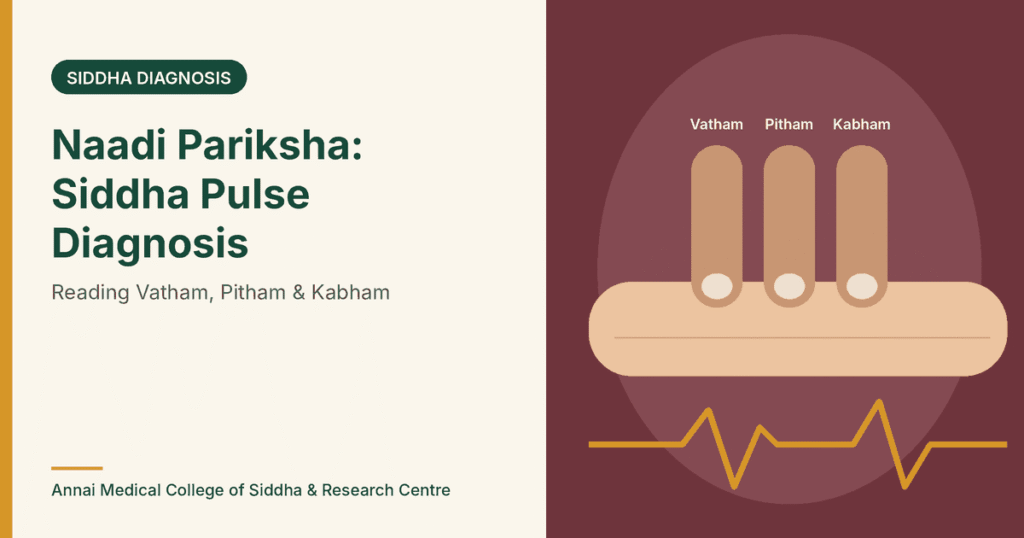
In Siddha pulse diagnosis, the physician examines the pulse by placing three fingers over the radial artery near the wrist.
Each finger is traditionally associated with one of the three vital forces:
- Index finger – Vatham: Represents the first vital force.
- Middle finger – Pitham: Represents the second vital force.
- Ring finger – Kabham: Represents the third vital force.
The practitioner observes the differences in pulse movement and characteristics under each finger. These observations are interpreted according to traditional Siddha principles.
The physician may also consider the patient’s age, physical condition, symptoms and other examination findings before making a diagnosis.
Naadi Parikshai requires experience and careful observation because pulse interpretation is a specialised skill within traditional Siddha practice.
3. The Three Vital Forces: Vatham, Pitham and Kabham
The Siddha system of medicine explains the body’s functioning through three fundamental forces called Mukkutram. These are Vatham, Pitham and Kabham.
| Vital Force | Pulse Position | Traditionally Associated With |
|---|---|---|
| Vatham | Index finger | Movement, breathing and nerve-related activities |
| Pitham | Middle finger | Heat, digestion and metabolic activities |
| Kabham | Ring finger | Stability, structure, strength and lubrication |
Vatham: Vatham is traditionally associated with movement and activity within the body. It is connected with functions such as movement, breathing and nerve-related activities in Siddha philosophy.
Pitham: Pitham is associated with heat, digestion and metabolic activities. It represents the processes involved in digestion and the body’s internal transformation.
Kabham: Kabham is traditionally associated with stability, structure and lubrication. It is connected with strength, physical support and maintaining balance within the body.
According to Siddha principles, these three forces work together to maintain health. An imbalance in their functioning is traditionally considered an indication of possible health disturbances. Naadi Pariksha helps Siddha practitioners assess these forces as part of their overall examination.
4. What Is Envagai Thervu?
Envagai Thervu is the eight-fold diagnostic examination followed in Siddha medicine. The Tamil term refers to eight methods of examining a person’s physical condition.
It helps Siddha physicians understand different aspects of the patient’s health rather than depending on a single observation. The eight examinations include:
- Naadi (pulse)
- Sparisam (touch)
- Naa (tongue)
- Niram (colour)
- Mozhi (speech)
- Vizhi (eyes)
- Malam (stool)
- Moothiram (urine)
5. Eight Methods of Siddha Diagnosis
The eight methods of Envagai Thervu are:
| Method | Meaning | What Is Examined? |
|---|---|---|
| Naadi | Pulse examination | Pulse movement and characteristics |
| Sparisam | Touch examination | Body temperature and physical sensations |
| Naa | Tongue examination | Tongue appearance and condition |
| Niram | Colour examination | Skin colour and complexion |
| Mozhi | Speech examination | Voice and speech characteristics |
| Vizhi | Eye examination | Eye appearance and condition |
| Malam | Stool examination | Stool characteristics |
| Moothiram | Urine examination | Urine characteristics |
The urine examination also includes two traditional methods:
- Neerkuri: Examines the physical characteristics of urine, such as colour, smell and appearance.
- Neikuri: Observes the pattern formed when oil drops are placed on the urine sample.
Together, these examinations provide a broader picture of the patient’s condition according to Siddha diagnostic principles.
6. Importance of Naadi Pariksha in Siddha Medicine
Naadi Pariksha holds an important place in traditional Siddha diagnosis because it helps practitioners assess the body’s internal balance through pulse examination.
Some of its traditional roles include:
- Understanding Mukkutram: Helps assess the balance of Vatham, Pitham and Kabham.
- Supporting clinical assessment: Provides additional information alongside other physical examinations.
- Identifying traditional pulse patterns: Helps practitioners interpret variations in pulse movement and characteristics.
- Holistic health assessment: Encourages the physician to consider the patient’s overall physical condition.
Naadi Pariksha should be understood as one component of traditional Siddha assessment, not as a replacement for appropriate medical investigations.
7. Is Siddha Pulse Diagnosis Different from Modern Pulse Checking?
Yes. Although both methods involve examining the pulse, their purposes and interpretations are different.
| Siddha Pulse Diagnosis | Modern Pulse Checking |
|---|---|
| Based on traditional Siddha principles | Based on modern medical science |
| Assesses Vatham, Pitham and Kabham | Measures pulse rate, rhythm and character |
| Uses traditional pulse interpretation | Uses clinical examination and diagnostic equipment |
| Forms part of Envagai Thervu | Forms part of routine physical assessment |
Modern medicine uses pulse examination to assess heart rate, rhythm and other cardiovascular indicators. Siddha pulse diagnosis interprets pulse characteristics through its traditional framework.
Both approaches have different diagnostic foundations and should not be treated as interchangeable.
8. Limitations of Naadi Pariksha
Although Naadi Pariksha is an established traditional Siddha practice, there are important limitations to understand.
- Requires specialised training: Accurate interpretation depends on the practitioner’s knowledge and experience.
- Traditional interpretation: The assessment is based on Siddha concepts that differ from modern clinical diagnostic standards.
- Should not replace medical tests: Blood tests, scans and other investigations may be necessary to identify specific health conditions.
- Needs further scientific validation: Traditional pulse interpretation should not be assumed to have independently established diagnostic accuracy for every disease.
Important Health Note:
Patients should consult qualified healthcare professionals and seek appropriate investigations when experiencing health problems.
9. Conclusion
Naadi Pariksha is an important traditional diagnostic practice in Siddha medicine. Through pulse examination, Siddha practitioners traditionally assess Vatham, Pitham and Kabham as part of the broader Envagai Thervu approach.
Understanding these diagnostic methods provides valuable insight into the principles and practices of Siddha medicine. However, traditional diagnostic techniques should be understood within their appropriate context and should not replace medically indicated investigations.
For students interested in exploring these traditional practices, Annai Medical College of Siddha and Research Centre, Kovilacheri, Kumbakonam, offers a BSMS educational pathway to study Siddha medicine and its fundamental principles.
If you are interested in building a career in Siddha medicine, explore the BSMS programme and learn more about the academic opportunities at Annai Medical College.
Frequently Asked Questions
Medical Disclaimer: This article is provided for educational and informational purposes only. Pulse diagnosis in Siddha medicine should be conducted by qualified practitioners and must not substitute for professional medical consultations, emergency care, or standard clinical investigations.