
• Last updated: 2026-11-05 • ~8 min read • Siddha External Therapies
- 1. What Is Varmam Therapy?
- 2. History and Origin of Varmam Therapy
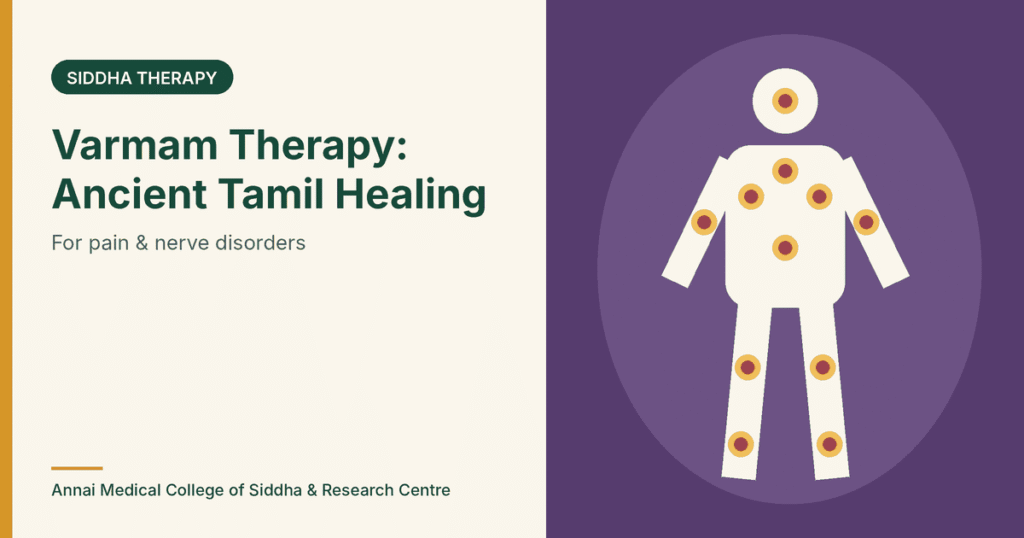
- 3. Understanding Varma Points in the Human Body
- 4. How Does Varmam Therapy Work?
- 5. Benefits of Varmam Therapy
- 6. Varmam Treatment for Back Pain and Other Conditions
- 7. What Happens During a Varmam Therapy Session?
- 8. Who Can Consider Varmam Therapy?
- 9. Safety Precautions and Possible Risks
- 10. Conclusion
- 11. Frequently Asked Questions (FAQs)
Tamil Nadu has a long history of traditional healing practices, and Varmam therapy is one of the important techniques within the Siddha system of medicine. Traditionally, it focuses on specific points in the body, known as Varma points, which are believed to be associated with nerves, muscles, joints and vital functions.
Varmam therapy uses carefully applied pressure and specialised techniques on these points. It is traditionally practised to help manage certain types of body pain, muscle stiffness and movement-related discomfort. It is also recognised as a prominent form of Siddha external therapy.
From back pain to neck stiffness, Varmam treatment has gained attention among people interested in traditional approaches to pain management. However, it should be performed by a properly trained practitioner, as incorrect pressure or manipulation can cause injury.
Varmam therapy is a traditional Siddha treatment that involves applying controlled pressure to specific Varma points in the body. It is traditionally used for pain relief, muscle stiffness and certain movement-related complaints.
Because Varma locations are interconnected with vital neurovascular structures, therapy must always be performed by a qualified Siddha physician with specialised clinical training.
1. What Is Varmam Therapy?
Varmam therapy is a specialised treatment method in Siddha medicine that involves applying controlled pressure or stimulation to selected points on the human body. These points are called Varma points and are traditionally associated with the body’s vital functions.
The practice is based on the belief that stimulating specific points can help regulate the body’s functioning and support relief from pain and physical discomfort.
Unlike general body massage, Varmam therapy follows specific techniques and point locations. The practitioner selects the appropriate points depending on the person’s symptoms, physical condition and traditional Siddha assessment.
It is considered one of the distinctive external treatment approaches in the Siddha system of medicine.
2. History and Origin of Varmam Therapy
Varmam therapy has its roots in ancient Tamil healing traditions and is closely connected with Siddha medicine. Siddhars developed and documented various traditional approaches to understanding the human body, health and treatment.
Traditionally, knowledge of Varma points was passed down through Siddha texts and specialised teaching practices. It was used in traditional healthcare to address physical injuries, pain and movement-related difficulties.
Over time, Varmam Maruthuvam became a specialised area within Siddha practice. Today, institutions such as the National Institute of Siddha (NIS) in Chennai provide specialised Varmam treatment and postgraduate education in Varmam Maruthuvam.
3. Understanding Varma Points in the Human Body
Varma points are specific locations in the body that are recognised in traditional Siddha medicine. These points are believed to be connected with important body functions, including muscular movement and nerve-related activities.
According to Siddha literature, Varma points are classified into different categories. Some commonly recognised classifications include:
- Padu Varmam: 12 major Varma points considered highly vital.
- Thodu Varmam: 96 points stimulated through therapeutic touch or pressure.
- Thattu Varmam: Techniques involving tapping or gentle percussion to stimulate specific points.
- Pakka Varmam: Points located adjacent to other major Varma points.
Each point has its own traditional significance and method of stimulation. The practitioner identifies the relevant points based on the individual’s condition rather than applying pressure randomly.
4. How Does Varmam Therapy Work?
Varmam therapy involves applying specific pressure, touch or controlled stimulation to selected points in the body. The technique and intensity depend on the condition being assessed.
A typical clinical approach involves:
- Initial assessment: The Siddha practitioner evaluates the patient’s symptoms, medical history and physical condition.
- Identifying Varma points: Relevant points are selected based on traditional Siddha assessment and palpable tissue tension.
- Applying controlled pressure: The practitioner uses specialised hand techniques and calculated pressure degrees to stimulate selected points.
- Monitoring the response: The patient’s comfort and clinical responses are observed continuously during treatment.
- Follow-up care: Further sessions or additional Siddha treatments (such as Thailam application or herbal fomentation) may be recommended.
The exact method varies from person to person. Varmam therapy should always be performed by a qualified Siddha physician with appropriate training.
5. Benefits of Varmam Therapy
Varmam therapy is traditionally used as an approach to managing certain musculoskeletal and movement-related complaints.
Some of its commonly discussed therapeutic applications include:
- Pain management: Traditionally used to address discomfort associated with the back, neck, shoulders and joints.
- Relief from muscle stiffness: Specific hand techniques help release muscular tightness and alleviate movement restrictions.
- Joint mobility: Practised for joint-related limitations with the aim of improving physical ease and functional movement.
- Movement-related difficulties: Used in Siddha practice as supportive therapy for selected neuro-musculoskeletal conditions.
- Traditional holistic care: Readily integrated alongside internal Siddha medications and dietary regimens.
Research Note: While these are recognized traditional applications, clinical research continues to evolve. Large-scale, rigorous trials are ongoing to further validate therapeutic efficacy across distinct health conditions.
6. Varmam Treatment for Back Pain and Other Conditions
One of the most frequent clinical applications of Varmam therapy is managing back pain, cervical issues and associated musculoskeletal conditions:
| Condition | Traditional Therapeutic Application |
|---|---|
| Lower back pain | Selected Varma point stimulation for pain management |
| Neck pain | Techniques used for neck stiffness and cervical discomfort |
| Cervical spondylosis | Used as a specialised Siddha treatment approach |
| Lumbar spondylosis | Considered for lower back discomfort and movement difficulties |
| Sciatica | Traditionally used for radiating nerve pain and related complaints |
| Osteoarthritis | Used as an external approach to managing joint discomfort |
| Muscle stiffness | Specific pressure techniques for muscular tension and spasm |
Clinical literature has highlighted positive outcomes in pain and functional mobility among patients with cervical spondylosis receiving Siddha Varmam therapy. However, small case series serve as preliminary findings, requiring larger trials to establish broad clinical efficacy.
Critical Warning: Back pain accompanied by progressive leg weakness, profound numbness, loss of bowel or bladder control, or numbness around the saddle/groin area requires emergency neurosurgical evaluation. Varmam therapy must never delay necessary acute medical interventions.
7. What Happens During a Varmam Therapy Session?
A typical therapy session follows a structured clinical procedure:
- Patient Assessment: The physician examines range of motion, palpatory tenderness and relevant medical scans.
- Treatment Preparation: The patient is positioned comfortably in a sitting or recumbent posture.
- Point Identification: The practitioner palpates and pinpoints the precise anatomical Varma locations.
- Therapy Application: Measured manual pressure, gentle friction or tapping techniques are administered.
- Post-Treatment Guidance: Patients receive advice on posture, hydration and follow-up visit intervals.
8. Who Can Consider Varmam Therapy?
Individuals experiencing chronic or subacute musculoskeletal complaints may discuss Varmam therapy with a qualified Siddha doctor. Suitable candidates often include those with:
- Persistent back, shoulder or cervical discomfort.
- Muscular spasms and restricted joint range of motion.
- Certain post-injury rehabilitation needs (under medical supervision).
- Selected chronic neuro-musculoskeletal issues.
Patients with active spinal fractures, acute neurological deficits, deep vein thrombosis, or severe osteoporosis require comprehensive medical evaluation before any manual therapy is attempted.
9. Safety Precautions and Possible Risks
Because Varmam techniques interface directly with nerve pathways and vascular bundles, adherence to safety guidelines is essential:
- Always receive treatment from a qualified Siddha physician with dedicated Varmam training.
- Never attempt self-manipulation or forceful pressure at home without professional knowledge.
- Disclose all current medications, prior surgeries and chronic health conditions.
- Do not replace emergency trauma care or required surgical care with manual therapy.
- Inform your doctor if you are pregnant, as certain abdominal and pelvic Varma points are strictly contraindicated.
10. Conclusion
Varmam therapy represents a vital discipline within Siddha external medicine, utilising precision stimulation of anatomical Varma points to alleviate pain, ease muscular tension and support joint function.
Its safe application depends entirely on authentic anatomical knowledge and certified clinical training. For aspiring medical students interested in studying traditional Tamil medicine and mastering practices like Varmam Maruthuvam, Annai Medical College of Siddha and Research Centre in Kovilacheri, Kumbakonam, provides an established undergraduate BSMS educational pathway supported by clinical hospital infrastructure.
Frequently Asked Questions
Medical Disclaimer: This article is provided for educational and informational purposes only. Varmam therapy must be administered by a qualified Siddha physician and should not replace emergency medical diagnosis, radiological investigations or prescribed conventional treatments for severe spinal and neurological conditions.