
• Last updated: 2026-11-05 • ~8 min read • Siddha Medicine Overview
- 1. What Is Siddha Medicine?
- 2. History and Origin of Siddha Medicine
- 3. Who Are the Siddhars?
- 4. Five Elements in the Siddha System of Medicine
- 5. Three Fundamental Principles of Siddha Medicine
- 6. Important Principles of Siddha Treatment
- 7. Common Siddha Treatments and Medicines
- 8. Potential Benefits of Siddha Medicine
- 9. Siddha Medicine in Modern Healthcare
- 10. Conclusion
- 11. Frequently Asked Questions (FAQs)
Siddha medicine is one of the oldest traditional systems of healthcare in India, with its roots deeply connected to Tamil culture and history. Originating in Tamil Nadu, this traditional medical system focuses on maintaining health, preventing illness, and supporting the body’s natural balance.
The Siddha system of medicine is based on the knowledge of ancient Siddhars, who developed treatments using herbs, minerals, natural ingredients, dietary practices, and lifestyle principles. It considers physical health, mental well-being, and the relationship between the human body and nature.
Today, Siddha medicine continues to be practised in India, particularly in Tamil Nadu. Understanding its history, fundamental principles, treatments, and potential benefits helps explain why this traditional healthcare system remains relevant.
Siddha medicine is an ancient Tamil system of traditional medicine that focuses on maintaining the balance of the body’s three vital energies (Vali, Azhal, and Iyyam) through herbal preparations, mineral formulations, dietary practices, lifestyle changes, and external therapies.
1. What Is Siddha Medicine?
Siddha medicine is a traditional Indian healthcare system that originated in Tamil Nadu. It is based on the belief that good health depends on maintaining harmony between the body, mind, and the natural environment.
The word “Siddha” comes from the Tamil word “Siddhi”, which refers to perfection, accomplishment, or spiritual attainment. The system was developed through the knowledge and practices of ancient Siddhars, who studied medicinal plants, minerals, the human body, and natural healing methods.
Unlike treatments that focus only on individual symptoms, the Siddha system of medicine considers a person’s age, physical condition, lifestyle, diet, and surrounding environment when approaching healthcare.
It includes several traditional practices, such as:
- Herbal and mineral-based medicines.
- Dietary recommendations and lifestyle modifications.
- Traditional external therapies and massages.
- Yoga, breathing exercises (Pranayama), and meditation.
- Preventive healthcare and rejuvenation practices (Kayakarpam).
Siddha medicine is an important part of Tamil traditional medicine and continues to be practised through government and private healthcare institutions, particularly in Tamil Nadu.
2. History and Origin of Siddha Medicine
Siddha medicine has a long history closely associated with ancient Tamil civilisation. Its knowledge was developed and passed down through generations of Siddhars, who documented their observations and medical practices in traditional Tamil literature.
The exact date of its origin is difficult to establish. However, Siddha medical concepts appear in several ancient Tamil literary and philosophical works.
How Did Siddha Medicine Develop?
The development of Siddha medicine can be understood through key stages:
- Ancient Tamil Period: Traditional knowledge about medicinal plants, food, health, and natural remedies developed organically within Tamil society.
- Siddhar Contributions: Ancient Siddhars expanded medical knowledge through empirical observations, experiments, alchemy (Irumboottu), yoga, and formulation preparation.
- Palm-Leaf Manuscripts: Medical principles, treatment methods, and complex formulations were systematically recorded on palm leaves (Olai Chuvadi) and preserved across generations.
- Institutional Development: Siddha medicine transitioned into structured medical education, research institutes, and clinical teaching hospitals.
- Modern Development: Today, Siddha medicine is officially recognized under the Ministry of AYUSH, Government of India, supported by dedicated bodies for education, clinical trials, and regulatory standardisation.
Who Is Considered the Father of Siddha Medicine?
Sage Agasthiyar (also known as Agathiyar) is traditionally revered as the father of Siddha medicine. He is believed to have made foundational contributions to Siddha medical philosophy, pulse diagnosis, and formulation science. His treatises hold an enduring place in classical Tamil medical literature.
3. Who Are the Siddhars?
Siddhars were ancient Tamil sages, scholars, physicians, and spiritual practitioners who founded and cultivated Siddha medicine. Traditionally, eighteen Siddhars, known as Pathinen Siddhargal, are considered the primary lineage masters of this system.
Some of the renowned Siddhars include:
- Agasthiyar
- Thirumoolar
- Bogar
- Theraiyar
- Yugimuni
- Konganar
- Karuvoorar
- Pambatti Siddhar
These scholars explored internal medicine, mineral processing, anatomy, surgery, toxicology, and therapeutic external treatments, laying the diagnostic framework of the Siddha system.
4. Five Elements in the Siddha System of Medicine
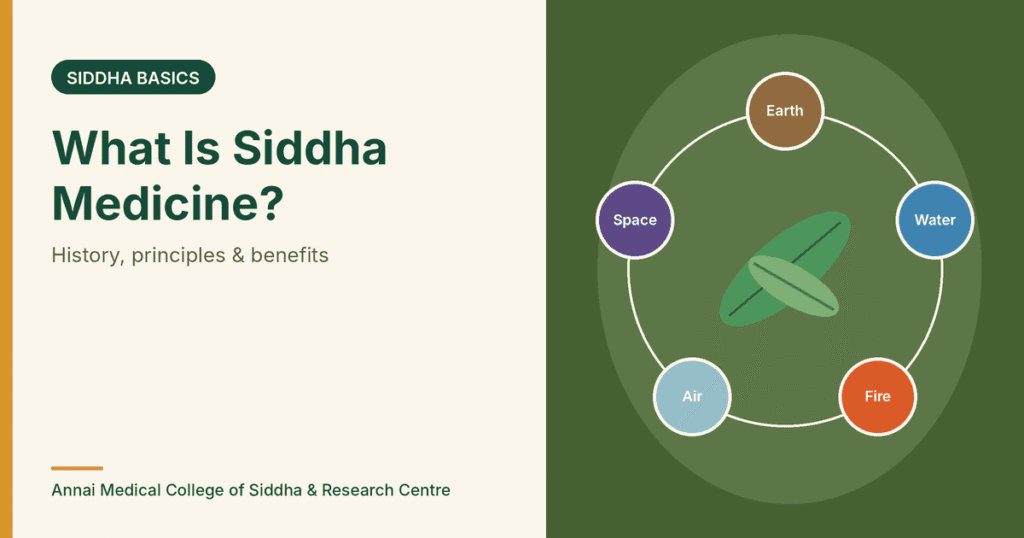
A fundamental premise of Siddha philosophy is Pancha Bootham (the five basic elements). According to Siddha cosmology, the human microcosm is composed of the exact same five primordial elements that constitute the universe:
| Element | Tamil Name | Traditional Significance |
|---|---|---|
| Earth | Mann | Structure, bone framework, and physical stability |
| Water | Neer | Fluid balance, blood, plasma, and nourishment |
| Fire | Thee | Digestive metabolic heat and biological transformation |
| Air | Kaatru | Respiration, sensory transmission, and muscular activity |
| Space | Aagayam | Internal cavities, cellular channels, and openness |
According to Siddha philosophy, an imbalance in these fundamental elements directly impacts physiological homeostasis, giving rise to bodily dysfunction or disease.
5. Three Fundamental Principles of Siddha Medicine
The three humours, collectively known as Mukkutram, are central to health and diagnosis in Siddha medicine. They represent the biological manifestations of the five elements within the human system:
| Humour | Associated Elements | Traditionally Associated With |
|---|---|---|
| Vali (Vatham) | Air and Space | Movement, respiration, neurological impulses, and circulation |
| Azhal (Pitham) | Fire | Digestion, enzymatic transformations, body temperature, and intellect |
| Iyyam (Kabam) | Earth and Water | Physical strength, joint lubrication, mucus protection, and structural integrity |
Why Are the Three Humours Important?
In a state of equilibrium (roughly in the ratio of 4:2:1 as described in classical literature), the body enjoys health. When dietary imbalances, environmental shifts, or mental stress disturb this equilibrium, illness ensues. A Siddha physician diagnoses this balance primarily through Naadi (pulse reading) and the eightfold clinical diagnostic system (Envagai Thervu).
6. Important Principles of Siddha Treatment
Siddha therapy focuses on addressing the root cause of systemic disharmony rather than suppressing symptoms alone:
- Individual-Based Treatment: Therapeutic choices are tailored to the patient’s constitutional type, age, geographic habitat (Thinai), seasonal conditions (Kaalam), and digestive fire.
- Importance of Food as Medicine (Unave Marunthu): Food is considered the primary medicine. Siddha emphasizes balance among the six tastes (Aru Suvai): Sweet (Inippu), Sour (Pulippu), Salty (Uparppu), Bitter (Kasappu), Pungent (Kaarppu), and Astringent (Thuvarppu).
- Lifestyle & Daily Routine (Naalozhukkam): Prescribes guidelines for sleep, morning regimens, exercise, and seasonal adaptations (Kaala Ozhukkam).
- Mind-Body Connection: Siddha integrates physical postures (Asanas), breathwork (Pranayama), and meditation to quieten mental fluctuations and foster long-term recovery.
7. Common Siddha Treatments and Medicines
Siddha pharmacology is extensive, utilizing botanical, mineral, and animal components across 32 internal and 32 external therapies:
- Herbal Medicines (Mooligai): Prepared from leaves, barks, roots, and flowers into forms such as Chooranam (powders), Kashayam (decoctions), Thailam (medicated oils), and Lehyam (confections).
- Mineral & Metal Preparations (Dhaathu / Kaarasaaram): Specialized purified metals and minerals processed into Parpam (calcined powders), Chendhooram (red calcined oxides), and Chunnam. These require meticulous multi-stage purifications (Suddhi) and must be taken under strict clinical supervision.
- External Therapies (Pura Maruthuvam):
- Thokkanam: Nine physical therapeutic manipulation and massage techniques.
- Varmam: Precision stimulation of vital energy junction points to alleviate neuromuscular issues.
- Poochu: External application of medicated pastes and oils.
- Ottradam: Warm fomentation using medicinal cloth boluses.
- Kayakarpam: A specialized science of longevity, cellular rejuvenation, and preventive therapy designed to delay degenerative processes and enhance immune resistance.
8. Potential Benefits of Siddha Medicine
When administered under professional guidance, Siddha medicine offers meaningful holistic wellness support:
- Focus on Preventive Healthcare: Empowers individuals with seasonal routines and nutritional guidelines to maintain health proactively.
- Personalised Healthcare Approach: Every treatment plan considers the individual’s physical constitution and digestive capacity.
- Support for Chronic Ailments: Provides supportive care for chronic conditions such as arthritis, respiratory disorders, dermatological issues, and metabolic lifestyle diseases.
- Comprehensive Dietary Guidance: Integrates balanced, unrefined local ingredients that complement medical recovery.
- Rejuvenation and Longevity: Rejuvenation therapies (Kayakarpam) and Varmam therapies promote vitality and mental relaxation.
IMPORTANT HEALTH NOTE:
These principles reflect traditional healing concepts, not unconditional guarantees of clinical cures. “Natural” does not automatically mean safe for unsupervised consumption. Complex mineral formulations must undergo standard pharmaceutical testing and should only be prescribed by registered Siddha physicians. Never stop or alter your prescribed conventional medical therapies without consulting your treating doctor.
9. Siddha Medicine in Modern Healthcare
Siddha medicine forms a recognized component of India’s pluralistic healthcare system under the Ministry of AYUSH. Key institutions advancing Siddha healthcare include:
| Institution | Role in Modern Healthcare |
|---|---|
| Central Council for Research in Siddha (CCRS) | Conducts, coordinates, and standardises scientific clinical research and drug trials in Siddha medicine. |
| National Institute of Siddha (NIS), Chennai | Provides postgraduate medical education, specialized hospital care, and clinical research facilities. |
| Approved Siddha Medical Colleges | Offer the 5½-year undergraduate Bachelor of Siddha Medicine and Surgery (BSMS) degree under NCISM regulations. |
Modern initiatives focus on scientific validation, Good Manufacturing Practices (GMP) in medicine production, and integrating Siddha departments into primary healthcare centres and wellness initiatives across the country.
10. Conclusion
Siddha medicine represents an enduring legacy of classical Tamil healthcare knowledge, codified by ancient Siddhars through acute observation of nature, human biology, and environmental rhythms. Rooted in the five elements and the balance of the three humours (Vali, Azhal, and Iyyam), it provides a holistic perspective on well-being.
From herbal decoctions and therapeutic Varmam massage to disciplined nutrition and restorative lifestyle routines, the Siddha system of medicine offers practical approaches to sustainable health. When approached with qualified medical oversight and supported by ongoing scientific evaluation, Siddha medicine remains an impactful medical science for contemporary healthcare.
Frequently Asked Questions About Siddha Medicine
General Disclaimer: This article is provided for educational and informational purposes only and does not substitute for direct clinical advice, diagnosis, or medical treatment. Always consult a qualified Siddha practitioner or healthcare professional regarding any medical condition or treatment plan.