
• Last updated: 2026-08-10 • ~8 min read • India
- What Is Siddha Medicine?
What Is Ayurveda?
Siddha vs Ayurveda: What Is the Difference?
How Does Diagnosis Differ Between Siddha and Ayurveda?
What Treatments Are Used in Siddha Medicine?
What Treatments Are Used in Ayurveda?
Which Is Better, Siddha or Ayurveda?
Is Siddha Better Than Ayurveda for Chronic Diseases?
Is Siddha Medicine Recognized in Tamil Nadu?
Siddha vs Ayurveda for Students: Which Should You Choose?
Siddha and Ayurveda Are Similar, But Not the Same
Final Thoughts
When it comes to traditional Indian medicine, Siddha and Ayurveda are two names you’ll hear quite often. Both have been practiced for centuries, both take a holistic approach to health, and both are recognized systems of traditional medicine in India.
But they are not the same.
Siddha has deep roots in Tamil culture and the southern parts of India, particularly Tamil Nadu. Ayurveda developed across the Indian subcontinent and has become widely known around the world. Their ideas about health, diagnosis, medicines, and treatment are also quite different.
So, if you are wondering which is better, Siddha or Ayurveda, there is no one answer that works for everyone. The right choice depends on what you are looking for, your health needs, and access to a properly qualified practitioner.
Let’s take a closer look.
Siddha and Ayurveda are both traditional Indian systems of medicine, but they developed through different historical and cultural traditions. Siddha has deep roots in Tamil culture and South India, particularly Tamil Nadu, while Ayurveda developed across the Indian subcontinent and has a wider international presence.
They also differ in their terminology, diagnostic traditions, medicines, and treatment approaches. Siddha refers to Vaadham, Pitham, and Kabam, while Ayurveda uses Vata, Pitta, and Kapha.
There is no universal winner between Siddha and Ayurveda. The right choice depends on individual circumstances, health needs, available evidence, and access to a properly qualified practitioner.
What Is Siddha Medicine?
Siddha medicine is one of India’s traditional systems of medicine and has particularly strong roots in Tamil Nadu and other Tamil speaking regions of South India.
The tradition is closely associated with the Siddhars, sages who are traditionally credited with developing and preserving knowledge related to medicine, yoga, spirituality, alchemy, and healthy living.
One of the things that makes Siddha special is its strong connection with Tamil language and culture. Much of its traditional knowledge has been preserved through Tamil medical literature.
Siddha looks at health as a state of balance between the body, mind, and the surrounding environment. Its traditional framework includes the five elements, earth, water, fire, air, and space, along with three fundamental humors known as Vaadham, Pitham, and Kabam.
The system also includes traditional approaches involving herbs, minerals, metals, external therapies, and practices such as Varmam.
What Is Ayurveda?
Ayurveda is another traditional Indian system of medicine and is probably the more familiar of the two internationally.
The word Ayurveda comes from Sanskrit and is commonly translated as “the science of life.” Its classical knowledge is associated with texts such as the Charaka Samhita and Sushruta Samhita.
One of the central concepts in Ayurveda is the balance of three doshas: Vata, Pitta, and Kapha.
According to Ayurvedic theory, these doshas influence different functions of the body. An Ayurvedic practitioner may consider a person’s constitution, symptoms, diet, lifestyle, and other factors when developing a treatment approach.
Ayurveda commonly includes herbal preparations, dietary changes, lifestyle practices, oils, massage, yoga, and therapies such as Panchakarma.
Because Ayurveda has become popular internationally, Ayurvedic clinics, wellness centers, retreats, and products can now be found in many countries outside India.
Siddha vs Ayurveda: What Is the Difference?
At first glance, Siddha and Ayurveda can seem very similar. Both emphasize balance, prevention, diet, lifestyle, and individualized care.
The differences become clearer when you look at their origins and traditional concepts.
Siddha is strongly associated with Tamil regions and has its roots in Tamil medical traditions. Ayurveda has a broader history across the Indian subcontinent and is closely associated with Sanskrit medical literature.
The two systems also use different terminology. Siddha refers to the three humors as Vaadham, Pitham, and Kabam, while Ayurveda uses the terms Vata, Pitta, and Kapha.
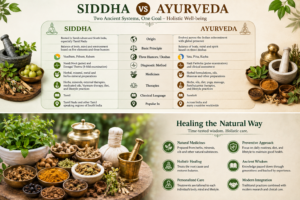
Their diagnostic methods and approaches to medicines also differ. Siddha has a distinctive tradition of using herbal, mineral, metal, and herbo mineral preparations, while Ayurveda is widely associated with herbal medicines, oils, dietary practices, and therapies such as Panchakarma.
Although both systems share certain underlying ideas, they developed independently enough to have their own distinct identities.
How Does Diagnosis Differ Between Siddha and Ayurveda?
Diagnosis is another area where Siddha and Ayurveda have similarities as well as differences.
In Ayurveda, diagnosis may involve pulse examination, physical examination, observation, and an assessment of symptoms, diet, lifestyle, and constitution. Nadi Pariksha, or pulse examination, is one of the better known traditional diagnostic methods.
Siddha also gives importance to pulse examination, known as Naadi Nool. However, Siddha traditionally describes an eight part diagnostic method called Envagai Thervu.
It involves examining the pulse, tongue, complexion, voice, eyes, touch, stool, and urine.
The basic idea in both traditions is to understand the person as a whole rather than looking at a single symptom on its own.
What Treatments Are Used in Siddha Medicine?
Siddha treatment can involve a combination of internal and external therapies depending on the individual and the condition being addressed.
Traditional Siddha medicine includes herbal medicines, herbo mineral preparations, mineral and metal based preparations, medicated oils, external therapies, dietary recommendations, lifestyle practices, and Varmam therapy.
Gunapadam is an important area of Siddha medicine that deals with medicinal substances and their preparation.
Some Siddha medicines involve minerals or metals, which makes proper preparation and professional supervision especially important. A medicine being traditional or natural does not automatically mean that it is safe for everyone.
If you are considering Siddha treatment, especially for a chronic condition or while taking other medicines, it is important to consult a qualified practitioner and let them know about any medicines or treatments you are already using.
What Treatments Are Used in Ayurveda?
Ayurvedic treatment can also involve several different approaches depending on the individual.
Common approaches include herbal formulations, medicated oils, Abhyanga or therapeutic oil massage, dietary changes, lifestyle recommendations, yoga, and traditional therapies such as Panchakarma.
Ayurveda often places considerable emphasis on daily routines, food, sleep, exercise, and other lifestyle factors alongside traditional medicines and therapies.
As with Siddha, treatment should not simply involve choosing an Ayurvedic product based on a general recommendation. A qualified practitioner should assess the individual before recommending medicines or intensive therapies.
Which Is Better, Siddha or Ayurveda?
This is probably the question most people want answered.
The simple answer is that there is no universal winner between Siddha and Ayurveda.
Both are traditional medical systems with their own approaches, and choosing between them should depend on your individual circumstances rather than popularity alone.
Ayurveda may be a more accessible option if you are interested in dosha based approaches to diet and lifestyle or want a system with a large international presence. Ayurvedic practitioners, wellness centers, and therapies such as Panchakarma are available in many parts of the world.
Siddha may be particularly appealing if you have an interest in Tamil traditional medicine or want to explore a system with deep roots in Tamil Nadu. Its traditional approaches to herbal and herbo mineral medicine, as well as practices such as Varmam, give it a distinct identity.
That does not mean one system is automatically more effective than the other for a particular disease. Evidence for individual traditional treatments varies, and traditional medicine should not be considered a replacement for necessary modern medical care.
Is Siddha Better Than Ayurveda for Chronic Diseases?
You may come across claims online that Siddha is better for chronic diseases, skin problems, or certain other conditions.
It is worth being careful with such claims.
Siddha has a long history of addressing a wide range of health conditions, and many people seek Siddha care for chronic and lifestyle related concerns. However, that does not mean Siddha is universally superior to Ayurveda.
The same applies in the other direction. Ayurveda should not automatically be considered better simply because it is more widely known internationally.
If you have a persistent or serious health problem, getting an appropriate medical diagnosis should come first. If you are interested in traditional medicine as part of your care, discuss it with qualified healthcare professionals.
Is Siddha Medicine Recognized in Tamil Nadu?
Yes. Siddha is an established Indian system of medicine and has a particularly strong presence in Tamil Nadu.
Students can pursue professional education through the BSMS, or Bachelor of Siddha Medicine and Surgery, program. The course combines traditional Siddha subjects with modern medical sciences and clinical training.
Students may study subjects such as Gunapadam, which focuses on Siddha pharmacology and medicinal substances, Udal Koorugal, which covers anatomy, Udal Thathuvam, which covers physiology and fundamental principles, and Noi Naadal, which focuses on diagnosis and pathology.
Students also receive clinical training in hospital settings.
For students from Tamil Nadu, studying Siddha can mean more than simply choosing a medical degree. It can also mean studying a medical tradition that is closely connected with the region’s language, literature, history, and cultural heritage.
Graduates can pursue careers in clinical practice, research, teaching, consulting, and other areas of Siddha medicine, subject to applicable professional and regulatory requirements.
Siddha vs Ayurveda for Students: Which Should You Choose?
If you are a student deciding between BSMS and BAMS, it is worth looking beyond which course is more popular.
Think about what genuinely interests you.
If you are fascinated by Tamil medical literature, Siddha pharmacology, Varmam, and the history of medicine in Tamil Nadu, BSMS could be a natural fit.
If you are more interested in Ayurveda’s dosha framework, its international presence, and the wider ecosystem of Ayurvedic education and wellness, BAMS may be worth exploring.
You should also compare the colleges you are considering. Look at their curriculum, faculty, clinical exposure, hospital facilities, location, and the career opportunities available after graduation.
Most importantly, choose a field that you can see yourself studying and practicing for years to come.
Siddha and Ayurveda Are Similar, But Not the Same
It is easy to group Siddha and Ayurveda together because both are part of India’s long tradition of traditional medicine. However, they have developed along different historical and cultural paths.
Siddha is deeply connected to Tamil culture and South India, while Ayurveda has a broader history across the Indian subcontinent and a much larger international presence.
Their ideas about health overlap in some areas, but their terminology, diagnostic traditions, medicines, and therapeutic practices are not identical.
That is what makes the comparison between Siddha and Ayurveda so interesting.
Final Thoughts
So, Siddha vs Ayurveda: which one is better?
There is no simple answer.
If you are choosing a system for healthcare, consider your individual needs, the condition you are dealing with, the evidence available for the treatment you are considering, and whether you can access a properly qualified practitioner.
If you are choosing between Siddha and Ayurveda as a career, look beyond the names of the courses. Consider the subjects you will study, the clinical experience you will receive, the institution, your long term career goals, and, most importantly, which medical tradition genuinely interests you.
Siddha and Ayurveda do not need to compete for the title of “best.” They represent two different and fascinating parts of India’s long history of traditional medicine.
Sometimes, understanding the difference is more useful than choosing a winner.
Frequently Asked Questions (FAQ)
What is the main difference between Siddha and Ayurveda?
Siddha is strongly associated with Tamil regions and Tamil medical traditions, while Ayurveda has a broader history across the Indian subcontinent. They also differ in terminology, diagnostic traditions, medicines, and therapeutic practices.
Which is better, Siddha or Ayurveda?
There is no universal winner between Siddha and Ayurveda. The appropriate choice depends on individual circumstances, health needs, available evidence, and access to a properly qualified practitioner.
Is Siddha medicine recognized in Tamil Nadu?
Yes. Siddha is an established Indian system of medicine and has a particularly strong presence in Tamil Nadu. Students can pursue professional education through the BSMS, or Bachelor of Siddha Medicine and Surgery, program.
What is the difference between BSMS and BAMS?
BSMS is the Bachelor of Siddha Medicine and Surgery program, while BAMS is the Bachelor of Ayurvedic Medicine and Surgery program. Students should compare their curriculum, clinical exposure, faculty, facilities, location, and long-term career goals when choosing between them.
Final Checklist
- Understand the historical and cultural differences between Siddha and Ayurveda.
- Compare their traditional terminology, diagnostic approaches, medicines, and therapies.
- Do not assume that Siddha or Ayurveda is universally better than the other.
- Consider your individual health needs and consult a properly qualified practitioner when seeking treatment.
- For persistent or serious health problems, obtain an appropriate medical diagnosis and professional care.
- If choosing a career, compare BSMS and BAMS based on curriculum, clinical exposure, institution, and long-term career goals.
- Choose a medical tradition based on your interests, goals, and the quality of education and clinical training available.
Disclaimer:
This article discusses Siddha and Ayurveda as traditional systems of medicine and is provided for general informational purposes. It should not be considered medical advice or a substitute for diagnosis or treatment from a qualified healthcare professional. Evidence for individual traditional treatments varies, and readers should consult appropriate healthcare professionals for personal medical decisions.